
What If the Next Competitive Advantage Isn’t Budget?


As AI lowers the cost of information, destination advantage may shift from budget size to stewardship intelligence: the ability to organize, interpret, and apply intellectual capital in service of community vitality and place stewardship.
Why AI May Increase the Value of Stewardship Intelligence in the Visitor Economy
For decades, competitive advantage in the visitor economy largely scaled with resources.
Larger destinations could afford more research, more marketing, more specialized expertise, and more sophisticated planning. They could attend more conferences, engage more consultants, conduct more studies, produce more content, and invest in specialized systems.
Smaller destinations often faced a structural disadvantage. Limited budgets frequently meant limited capacity.
While exceptional leadership could overcome some of these constraints, the general relationship remained relatively stable:
More resources often translated into greater capability and influence.
Artificial intelligence is now altering that equation.
Not eliminating it.
Altering it.
The tourism industry has understandably focused much of its early AI conversation on tools: content creation, trip-planning applications, chatbots, itinerary builders, workflow automation, and research assistance.
These tools matter.
But they may not represent the most significant long-term implication of AI.
The more important question may be this:
What happens when intelligence becomes dramatically less expensive to generate, organize, interpret, and apply?
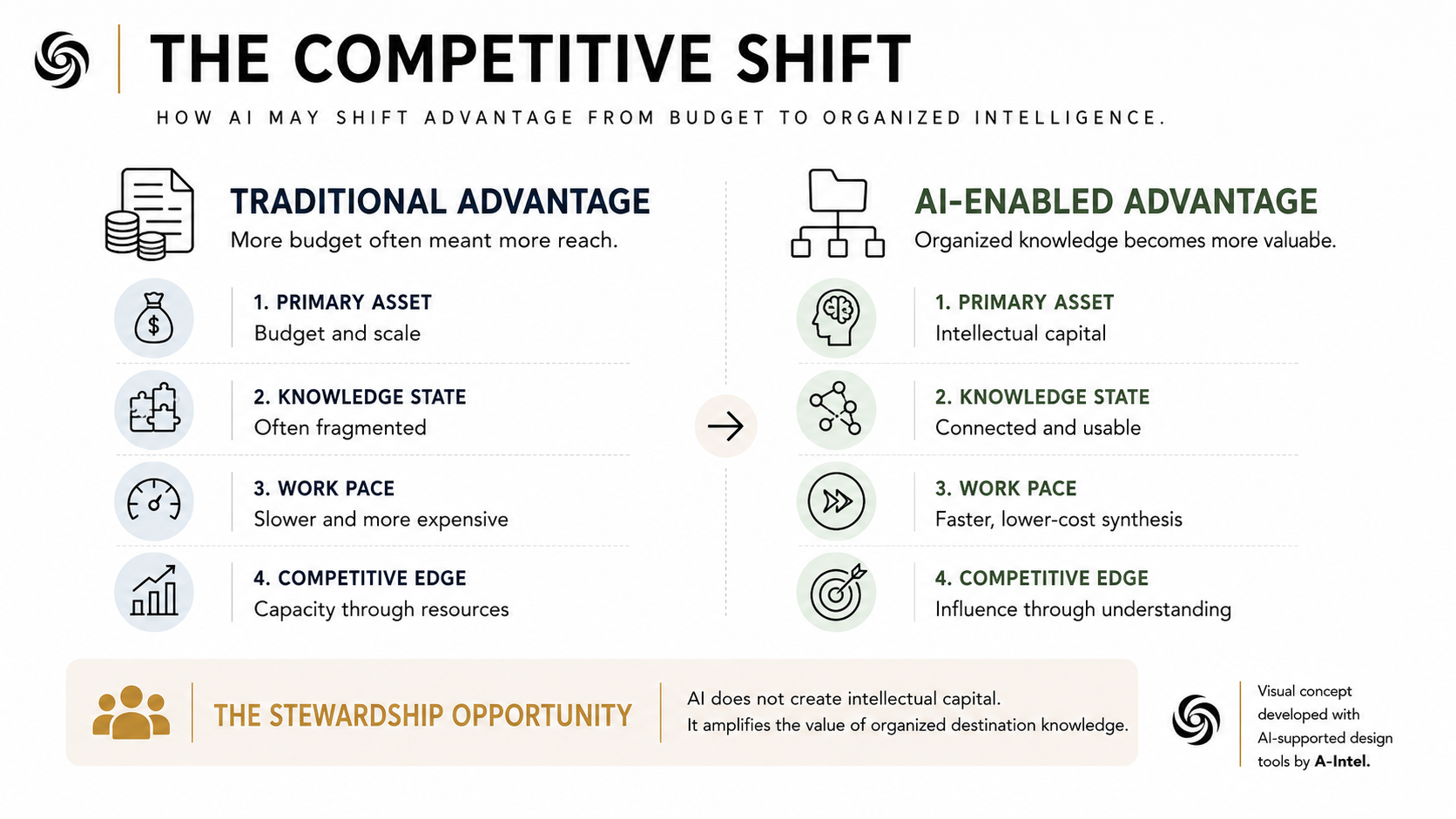
This shift matters because many destinations already hold far more intelligence than they realize.
From Tools to Stewardship Intelligence
Destinations often think about assets in physical, financial, or promotional terms: hotels, attractions, venues, media budgets, visitor volume, brand reach, and campaign performance.
But in an AI-enabled visitor economy, another asset class becomes increasingly important:
Intellectual capital.
Every destination holds knowledge about place, visitors, residents, stakeholder relationships, local culture, history, identity, governance realities, community priorities, operational pressures, and emerging visitor behaviors.
These are not simply data points.
They are intelligence wells: reservoirs of knowledge, memory, relationships, stories, data, lived experience, and contextual understanding already present within the destination system.
The challenge is that these wells are often disconnected. They live in staff experience, resident conversations, partner relationships, research reports, board discussions, strategic plans, community memory, cultural institutions, and informal knowledge networks.
The issue is not that destinations lack knowledge.
The issue is that much of their knowledge is fragmented, informal, inaccessible, or under-interpreted.
This is where the AI conversation becomes larger than tools.
Artificial intelligence does not simply give destinations new ways to produce content. It also rewards organized knowledge: clarity, structure, context, and discoverability.
But organization alone is not enough.
Knowledge becomes strategic only when it is interpreted.
The Missing Layer Is Interpretation
Destinations do not simply need more information.
They need the capacity to understand what information means in context.
A visitor trend is not just a marketing opportunity. It may also reveal pressure on resident quality of life.
A stakeholder concern is not just feedback. It may reveal a trust gap.
A cultural asset is not just content. It may reveal identity, memory, and responsibility.
An emerging behavior is not just demand. It may reveal a readiness question.
This is where interpretive intelligence becomes essential.
Interpretive intelligence is the ability to contextualize information, understand its implications, and determine how it should inform action. It helps destination leaders move beyond observation and toward meaning.
These questions matter because destination leadership increasingly requires more than promotion.
It requires judgment, alignment, and stewardship.
AI can help destinations surface patterns, synthesize information, improve discoverability, and make knowledge more usable.
But AI does not replace context, trust, judgment, or interpretation.
The competitive shift is not from humans to machines.
It is from fragmented knowledge to organized intelligence.
Stewardship Intelligence as Advantage
Stewardship intelligence is the practice of organizing and interpreting destination knowledge in service of community vitality, place stewardship, and more coherent decision-making.
It is not intelligence as prediction alone.
It is intelligence as orientation.
AI does not create intellectual capital.
It amplifies it.
A destination with weak understanding of itself will not suddenly become strategically intelligent because it adopts AI tools. In many cases, it may simply generate larger volumes of generic content, shallow analysis, or disconnected recommendations.
Conversely, a destination with strong intellectual capital may discover that AI increases its ability to organize knowledge, identify patterns, communicate insights, support decision-making, and improve discoverability.
The advantage, then, is not simply having access to AI.
The advantage is having something meaningful for AI to work with.
This is the foundation of AI-enabled stewardship intelligence infrastructure.
Not one dashboard.
Not one report.
Not one AI platform.
Rather, it is the capacity to organize, interpret, connect, and apply destination knowledge in service of long-term community vitality and place stewardship.
AI can enable this infrastructure.
But AI is not the infrastructure by itself.
The Destinations That Understand Themselves May Lead
This matters for destinations of all sizes, but especially for small and mid-sized destinations.
For years, limited resources often restricted access to capabilities that larger organizations could more readily afford. AI may begin to change the economics of that reality.
This does not mean budget no longer matters.
It does.
Infrastructure matters. Staffing matters. Investment matters. Technology access matters. Leadership capacity matters.
But the relationship between resources and influence may be changing.
The advantage may no longer belong only to those who can buy the most capacity. It may increasingly belong to those who can organize, interpret, and activate the knowledge they already hold.
The question is not simply:
What AI tools should we use?
The deeper question is:
What knowledge do we hold, where does it live, and how do we make it useful for stewardship?
Where are your destination’s intelligence wells?
What knowledge remains underutilized?
How effectively is it organized?
How well is it interpreted?
These are not simply research questions.
They are stewardship questions.
AI changes the economics of information.
But stewardship intelligence determines whether that information becomes useful, trusted, and aligned action.
In an era of accelerating change, intellectual capital may become one of the most valuable assets a destination possesses.
And the destinations that build the capacity to steward that intelligence may be the ones best positioned to lead.

Brian Applegarth is the founder of Applegarth Intelligence, a research and interpretive intelligence firm focused on destination stewardship, visitor economy systems, and community vitality. He led the Cannabis & Hemp Task Force for Destinations International and is the author of Learning Under Pressure.
Share Your Expertise
Want Your Organization Featured Next?
The article you just read was written by someone like you. Submit a blog, case study or social media feature and get your organization's story in front of the DI community.
Join 50+ destination leaders who've shared their stories on the DI Blog