5 Lessons for Building AI Capability Across Destinations

Destination organizations are embracing AI, but using the tools is only the beginning. Results from Destinations International’s AI Maturity Assessment pilot uncover gaps in organizational readiness and five lessons to help destinations turn AI adoption into lasting, measurable value.
Submitted on behalf of DI's Marketing Committee and AI & Technology Subcommittee
The destination marketing industry has embraced AI tools. Now comes the harder part: building the capabilities to use them effectively. Visit Tucson builds stakeholder reports with it. Visit Florida staff use it to pull answers from their Salesforce data. Visit Estes Park’s chatbot answers visitor questions on Facebook, WhatsApp and Instagram. Examples like these show what’s possible, and the next step for our industry is turning that use into something repeatable, measured and governed.
Destinations International’s 2025 DestinationNEXT Futures Study identifies generative AI and changing traveler behavior as forces reshaping destination marketing. It points us to the need for new organizational capabilities and intentional ways of working.
As we looked at AI adoption across our industry, we wanted to better understand whether organizations had the strategy, data, technology, people and governance in place to support it.
Building on earlier AI assessment work with Altaz Valani of Info-Tech Research Group, I introduced a DMO AI Maturity Assessment pilot through Destinations International’s Marketing Committee AI & Technology Subcommittee, working with my co-chair, James Sauter, Rove, and fellow committee members. We wanted to understand what’s working, where improvement is needed and where organizations should focus.
When we reviewed aggregated results from the early pilot, one finding stood out: data readiness was the lowest-scoring dimension in both groups. We’re using artificial intelligence, but our data isn’t ready to support the next generation of workflows and visitor experiences.
How the Pilot Assessment Works
Whereas an AI tool is a product that simply helps someone complete a task, AI capability is a repeatable, governed process that delivers measurable value to the DMO.
The AI maturity model worked on by the Subcommittee looks at seven dimensions to evaluate the overall AI readiness of DMOs:
- Strategy and Leadership
- Governance, Risk and Ethics
- Use Cases and Adoption
- Data Readiness
- Talent and Culture
- Technology and Infrastructure
- AI Search Visibility and Zero-Click Readiness
The maturity model looks at seven dimensions, shown in Figure 1.
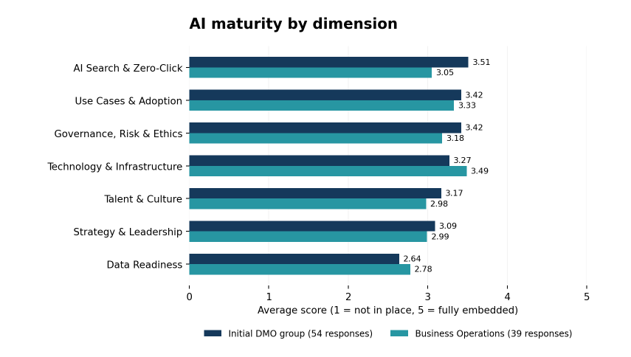
Each dimension has four statements — 28 in total. Each statement is scored from maturity score 1 (not in place) to maturity score 5 (fully embedded across the organization). We tested the assessment with Destinations International’s Marketing Committee, receiving 54 delegate responses. During the 2026 DI Business Operations Summit, our session From AI Tools to Organizational Capability: A DMO AI Maturity Model (Powered by CDME) generated an additional 39 responses. These are two self-reported groups that may overlap and are not a representative industry sample.
After reviewing the initial findings from these two groups, we uncovered a few key learnings that may be helpful to destinations trying to integrate AI into their day-to-day workflows.
Lesson 1: Success is Driven by Measuring Value, Not Usage
Staff are using AI, but we’re not yet measuring the value.
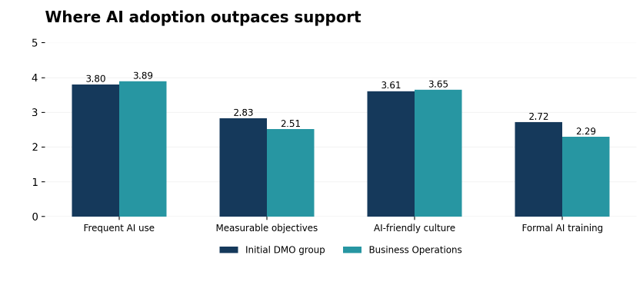
In the initial Marketing Committee group, frequent staff use scored 3.80 out of a possible 5, while alignment with measurable objectives scored 2.83. The Business Operations session showed the same gap: 3.89 for usage and 2.51 for objectives.
DMOs are clearly using the AI tools, but we’re rarely measuring what we get out of them.
Next steps: Pick one or two valuable use cases and track them for 90 days. For example, Visit Raleigh’s website AI agent, for example, saved about 269 staff hours in fiscal year 2025–26. DI’s micro-learning Measuring What Matters with AI can help you pick the right indicators, as licenses, logins and token use don’t tell us whether AI is helping.
Lesson 2: You Reap From AI What You Sow with Data
Data readiness remains our biggest shared challenge.
Data readiness averaged 2.64 in the initial group and 2.78 in the Business Operations session. Integration across systems scored just 2.46 in the initial assessment. In the Business Operations results, Technology and Infrastructure scored highest (3.49) and Data Readiness lowest (2.78) Many of us have CRM, content, research and reporting platforms, but those systems often can't share reliable, current information. What's often missing is the infrastructure to bring that information together, whether through a centralized data repository, a data lake or integrations that allow systems to securely access and share information.
At Visit Raleigh, we saw firsthand why data readiness goes beyond having information stored in one place. Ahead of the 2026 Stanley Cup Final, we connected our AI agent on visitRaleigh.com with the Carolina Hurricanes' agent, both powered by Satisfi Labs. Rather than combining all the information into a single repository, each organization maintained its own content while making trusted information accessible across both platforms. A fan checking puck drop time on the Hurricanes' site could also ask where to eat near Lenovo Center and receive information from Visit Raleigh without leaving the conversation. Across the Stanley Cup Final and the surrounding weeks in June 2026, the connected agents handled nearly 4,000 conversations, with 43.5% occurring outside staffed hours.
Explore St. Louis, for example, connected its CRM and event management system so teams work from the same records, the kind of consistent data AI depends on.
The lesson is that AI readiness isn't just about centralizing data. It's about ensuring information is accurate, accessible and connected so AI can deliver useful answers when visitors need them. For DMOs, this doesn't necessarily mean replacing existing systems or building a data lake overnight. It starts with understanding where information lives, identifying gaps in connectivity and making sure trusted data can be accessed across the platforms that serve visitors, partners and staff.
Lesson 3: Knowledge of AI Drives the Culture
An AI-friendly culture doesn’t replace training.
In the initial assessment, support for AI experimentation scored 3.61, while formal training scored 2.72. In the Business Operations group, the scores were 3.65 and 2.29. So, staff tend to experiment without understanding data confidentiality, accuracy or where AI needs human review.
At Visit Raleigh, quarterly AI training sessions are scheduled with the team and serve as a focused opportunity to revisit our AI policy and use real examples to show what good results look like, where answers can go wrong and which tools and information are approved. With AI tools changing constantly, regular hands-on practice matters more than a one-time demo. DI’s micro-learnings and Prompt Library can give those sessions ready-made content.
Lesson 4: Trust AI but Always Verify
Governance is about protecting trust.
Destination organizations have a responsibility to represent their communities, partners and visitors accurately. Think about what happens when a DMO shares an AI-generated image that doesn't reflect the actual destination or publishes AI-generated content without checking the facts. Both can raise questions about credibility and damage the trust we've worked hard to build. That's why AI governance is about more than having a policy. It's about making sure staff understand what AI can be used for, what needs to be reviewed and who is responsible before content goes public. Governance scored among the higher dimensions (3.42 and 3.18), so many of us have a policy on paper. The harder part is putting it into practice.
Ask who approves new AI uses or AI-generated content, what data staff can share with AI tools, and who reviews public-facing information. Make those responsibilities part of everyday operations, then revisit them as technology and vendor capabilities change.
Advocacy messaging is one way to put that review process into practice. If you use AI to draft a message for local officials, give it verified local data and have a staff member check the facts and local context before sharing. DI’s Advocacy & Action Messaging Guide includes a sample prompt and guidance on what to review before publishing.
Lesson 5: AI Search is Changing Destination Discovery
Travelers can receive destination recommendations directly from AI platforms without visiting destination marketing websites. That’s why the AI maturity model asks whether we monitor those answers, structure content for retrieval, and measure AI-driven visibility and influence. AI Search was the initial group’s highest-scoring dimension (3.51), a good sign that DMOs already see AI discovery as a priority. The next step is confirming that confidence by checking what AI platforms actually tell travelers.
For your destination, choose 10 common traveler questions, test them on several AI platforms and record whether the answers are accurate and cite appropriate destination sources. Repeat the review monthly or quarterly. If you work with an outside agency for ongoing SEO or GEO support, be sure to ask for their insights into how your destination appears within AI tools, and how they are adjusting their strategy to ensure your website’s content is relevant, extractable and perceived as the authority for these AI systems. DI’s recent post on how search has changed, while last year’s Embracing the Future of Search webinar offers practical steps for making content citable.
Building Capability Together
A perfect score within the maturity model is likely not possible, and may never be given the rate at which these tools evolve. What matters is being honest about where we are today and deciding where to focus efforts within our organizations to keep pace with these systems. For some DMOs, that may be more frequent training, or perhaps focusing on developing an AI policy. For others, it could mean better data synchronization or business measurement implementation.
DestinationNEXT identifies the broader industry forces. Our pilot adds a practical way to discuss readiness. As more DMOs participate in the future, we can learn where capabilities are developing and where shared resources may be useful.
We’ll keep sharing what we learn as the pilot grows, but for now, we’d recommend DMOs pick the one area above where your team feels least ready and start there.

Vimal Vyas is Vice President of Data, Security and AI Innovation for the Greater Raleigh Convention and Visitors Bureau. He is responsible for the Bureau's integrated digital efforts, including artificial intelligence (AI), digital product (web/mobile) development, data integration, cloud-based software solutions, infrastructure, content/Internet marketing technologies and business intelligence.
In 2023 Vyas earned Destinations International's Certified Destination Management Executive (CDME) credential, which signals the destination marketing industry's highest educational achievement. Vyas currently is a member of Destinations International’s Marketing Committee and serves as Co-Chair of the 2025 Marketing AI and Technology Subcommittee as well as a member of the Event Impact Calculator Super User Group.
Share Your Expertise
Want Your Organization Featured Next?
The article you just read was written by someone like you. Submit a blog, case study or social media feature and get your organization's story in front of the DI community.
Join 50+ destination leaders who've shared their stories on the DI Blog