
Specificity Is the New Reach: 5 Ways to Stand Out in AI Trip Planning

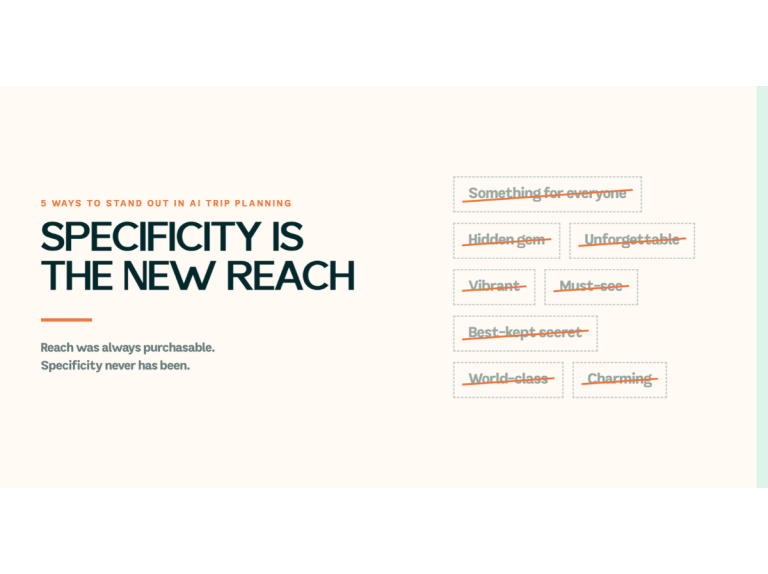
AI is changing how visitors decide where to go, not just how they book. Using persona work from Visit Corpus Christi, this post shows why specific, named, checkable detail now matters more than reach, with five no-budget ways any destination can make its story easier for AI assistants to repeat.
If you've ever sat through a persona workshop, you already know how this goes. Somebody uncaps a marker, somebody else says "let's give her a name," and an hour later a fictional woman from your top drive market has a favorite margarita, a car and strong opinions about outlet malls.
I've run that workshop. In 2018, my team at Visit Corpus Christi built one persona per drive market, and I drew them on the whiteboard myself. Vickie from San Antonio loved margaritas and TJ Maxx. Jordan from Austin was 32, with a rescue dog and a Jeep. Daniel from the Valley had two kids and appreciated a discount but would never ask for one. I loved those people. I still do.
When I pulled that deck back out this year, I noticed something I'd missed the first time. The part of that work that has aged best isn't the people. It's the itineraries we wrote next to them.
Discovery moved, quietly
Most of the AI news in travel is about booking: the assistant that reserves the room, the agent that buys the flight. But destination organizations have rarely owned the transaction. Our work sits upstream, in the moment a visitor is still deciding whether we're even on the list.
That moment is exactly where AI is showing up. In Longwoods International and Miles Partnership's American Travel Sentiment research, 29% of people who used AI to plan a recent trip used it to decide which destination to visit, while 21% used it to book. And Future Partners reported in April 2026 that AI trip-planning use had reached "30.2 percent of American travelers," up from roughly 24% a year earlier.
None of this makes brand tracking obsolete, and I'm not suggesting anyone cut it. Brand lift is still how we show a board we're holding our position. What's changed is that a growing share of consideration now gets assembled in seconds, inside a conversation, out of whatever specific material about a place is available to draw from.
The visitor is known. The destination is the scarce part.
Personas existed because we could never see the actual visitor, so we built composites. Researchers who generated 10,000 persona-style descriptions from real survey data found that even the best-performing ones matched no one at all once they combined nine or more attributes, in every consumer dataset they tested. Vickie carried sixteen.
An AI assistant doesn't need Vickie. It's talking to the real person, who has already mentioned her kids' ages and the beach trip she didn't love. What it needs from us is the other half of the page: the itinerary.
Jordan's read: paddleboarding, beer yoga at Nueces Brewing, dinner at Costa Sur Wok, the sea turtles, brunch at Hester's Cafe and the Art Museum of South Texas. Daniel's read: the Texas State Aquarium, fishing, four-wheeling on the beach, Snoopy's and Panjo's Pizza. Real, named, checkable places, tied to who they're for and when to go. That is the raw material an AI answer gets built from.
For twenty years, getting into a consideration set was largely a function of reach, and reach was something you bought. Specificity isn't for sale. You can't buy having something real to say about your community. That's good news for every destination, and especially for the smaller ones.

5 ways to make your destination more specific
1. Pull the itineraries out of your persona decks. Most of us have them sitting in old strategy documents. Publish them as real content: named places, who each stop is for and what time of year it's best. "Best in April, when locals go" will always beat "something for everyone."
2. Run a sameness sweep on one page. Pick your highest-traffic landing page and search it for unforgettable, hidden gem, vibrant and something for everyone. Replace each one with a named, checkable detail only your community could claim. It takes about two hours and no budget.
3. Use the words visitors use, then give them a room behind the door. If visitors search for "hidden gems in Texas" and that phrase never appears in your content, you've opted out of the category. But the phrase alone is an empty doorway. Follow it with the specific spring-fed swimming hole, how long the drive is and when to go.
4. Write to the question, not the demographic. Ask your visitor center staff, your social team and your front-desk partners for the questions they hear every week. Answer those questions on your website in plain, complete sentences. A visitor's real question is a better brief than any segment.
5. Make it a 20-minute monthly habit. Once a month, have a few staff members ask an AI assistant the real questions visitors ask about trips like yours, without naming your destination, and share what comes back. These tools give different answers to the same question, so one answer is a snapshot rather than a measurement. But the habit builds AI literacy across the whole team, quickly and at no cost.
The most level playing field in twenty years
The acronyms will keep coming. Underneath every one of them is the job our industry has always had: know your community well enough to say something no other place could say, and say it where visitors are looking.
When I look back at Vickie and Jordan now, I'm not embarrassed by them. I'm a little proud of their itineraries. We had the right material the whole time. We just put it on the wrong half of the slide.

Emily Zertuche, CDME, is the founder and CEO of Zertura, which measures how AI assistants describe destinations. She spent eleven years at Visit Corpus Christi, rising from content strategist to Chief Marketing Officer and then Chief Brand and Innovation Officer. She serves on Destinations International's AI Committee and Marketing Committee, is a DI 30 Under 30 alum, and writes Signals, a Substack newsletter for destination marketers.
Share Your Expertise
Want Your Organization Featured Next?
The article you just read was written by someone like you. Submit a blog, case study or social media feature and get your organization's story in front of the DI community.
Join 50+ destination leaders who've shared their stories on the DI Blog