
If Residents Use Accessibility Features 10 Times as Often as Visitors, Why Does the Tourism Bureau Pay for It Alone?

A traveler who uses a wheelchair check into a hotel, settles into her room, and makes a frustrating discovery: she cannot open her own guest-room door. Fire codes require the door to be heavy and self-closing. Traditionally, retrofitting that single entryway with an automated opener meant a commercial quote of between $5,000 and $10,000—a cost barrier that frequently stalls progress. Today, a newer device does the exact same job for about $1,750 and installs in ten minutes.
In the modern landscape of accessibility, engineering is rarely the obstacle. The real obstacle is a systemic question that is catching up to local governments: Who pays?
Right now, that question is landing squarely on destination organizations at the worst possible moment. The tourism occupancy taxes that historically funded these bureaus are increasingly contested. In a recent industry survey, roughly 42% of destination organizations reported that their budgets are under threat as cities move to redirect lodging-tax revenue into general funds for affordable housing, sanitation, and other core civic services.
In response, many bureaus are shifting their mandates, rebranding from destination marketing organizations into destination management organizations. They are taking formal, structural responsibility for the shared ecosystem that residents and visitors both depend on.
But consider the lopsided arithmetic this responsibility creates. When a tourism bureau funds an accessible asset—whether a specialized ramp, a sensory-friendly museum hour, or reliable digital route information—an out-of-town visitor might utilize it once a year. A local resident living with a disability utilizes it constantly: the restaurant fifty times, the museum monthly, the transit system every single working day.
We do not ask the tourism bureau to pave municipal roads or run the city buses. Yet, accessibility has quietly become the exception. Destinations are being asked to build accessible communities out of shrinking marketing budgets, covering much of the cost of innovations in physical infrastructure whose heaviest users are the people who live there.
This kind of work becomes far easier to fund if we rename the mission. What destinations are really building is not a checklist of compliance features; they are building independence. They are establishing the physical, digital, and informational systems that let a person of any age living with a disability take part fully and with dignity in a place.
This market is no longer a niche sub-sector; it is the absolute mainstream. In Longwoods International’s American Travel Sentiment Study, 17% of travelers report that someone in their party requires accessibility services—a share that closely mirrors the baseline disabled population of any community.
Furthermore, we are standing on the precipice of a demographic "Silver Tsunami." By 2030, every single baby boomer will be 65 or older. McKinsey & Company projects that 30 million Americans over 65 will be living with a disability. Boomers hold roughly half of all U.S. household wealth, with an average net worth of $1.2 million per household. As this generation moves into their seventies and eighties, the line between "aging" and "disability" effectively disappears.
Using a Travel Oregon grant, Arica Sears, Director of the Oregon Coast Visitors Association, purchased mobi-mats and a beach wheelchair to attract disabled tourists. However, pre-checkout waiver data revealed that residents actually used the features ten times more than visitors did.
For millions of older adults, especially veterans, features like accessible transit and automatic doors can make the difference between aging at home with dignity and moving into assisted living. In 2026, the national median cost of assisted living reached $75,756 a year. At the same time, states are tightening safety nets; California recently reinstated its $130,000 Medi-Cal asset limit for long-term care, narrowing access to state-subsidized care without asset depletion.
When a community invests in accessibility, it keeps seniors independent at home and out of subsidized care. TravelAbility calls the immense financial and social value created by this baseline autonomy the “Independence Dividend.”
Calculating the Return on Independence (ROI)
The economic impact of keeping a single individual independent for one year totals roughly $117,730 per person each year.
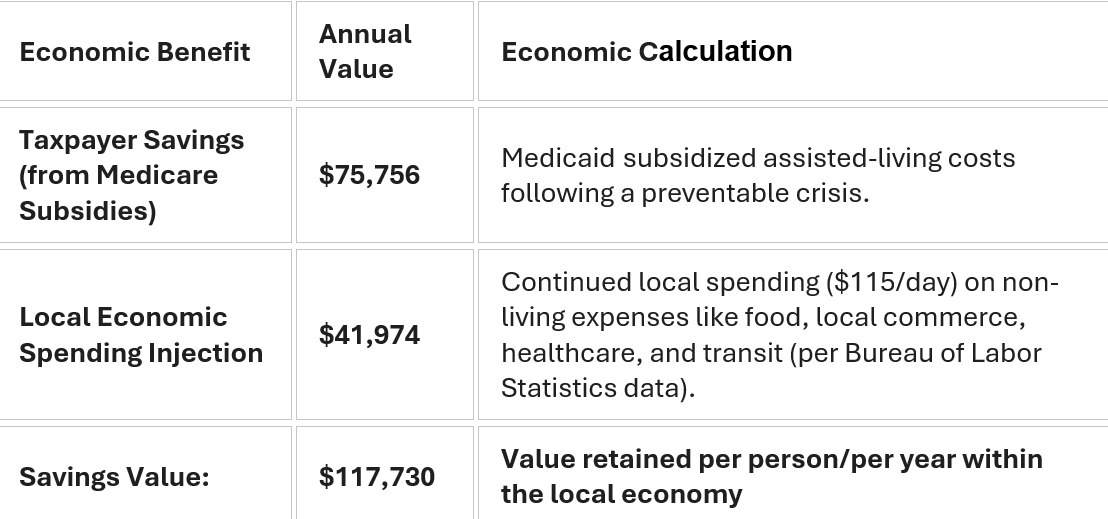
Crucially, this $117,730 dividend does not land on the ledger of the tourism bureau. It lands on hospital systems that see fewer crisis emergency admissions; on local employers who retain experienced older team members; on municipal budgets carrying lighter long-term-care obligations; and on main street businesses that keep an active, affluent customer. Independence pays a massive compound return across the entire civic spectrum.
This is where a systemic provocation turns into a collaborative invitation. If the dividend is shared, the cost must be shared.
City halls, healthcare networks, economic development agencies, private employers, and tourism bureaus all draw from the exact same economic well. A destination management organization is perfectly positioned to convene this table—to coordinate accessibility assessments, set localized information standards, and manage the digital infrastructure around accessibility.
But it cannot be asked to bankroll the entire table by itself.
We already have proof of concept for this collaborative approach. Oregon committed approximately $9 million in state grants to assess accessibility at more than 750 locations across the state using Wheel the World’s platform. While the physical fixes proved remarkably inexpensive—often eligible for separate infrastructure grants—the largest immediate return was reputational. The state generated hundreds of millions of impressions of favorable media coverage, the exact type of earned exposure destinations usually spend millions of marketing dollars trying to buy. Direct travel bookings became almost beside the point; the state successfully upgraded its core civic infrastructure while positioning itself at the forefront of the longevity economy.
In 2026, America celebrates its 250th anniversary. This country was founded on a revolutionary, hard-fought idea about independence. The next fifty years will test a broader, more mature evolution of that ideal: the belief that growing older, getting injured, or being born with a disability does not disqualify a person from the full, vibrant life of a community.
Destinations can and should lead this effort. But because independence benefits everyone, everyone who gains from it should help pay for it.

Share Your Expertise
Want Your Organization Featured Next?
The article you just read was written by someone like you. Submit a blog, case study or social media feature and get your organization's story in front of the DI community.
Join 50+ destination leaders who've shared their stories on the DI Blog