
Incentive Travel Sentiment Is Shifting Fast. Destinations Need to Be Ready.

The latest SITE Pulse Survey shows that incentive travel demand is no longer shaped only by appeal, access, infrastructure and experience. It is also being shaped, in real time, by perception.
For destination organizations, incentive travel has always offered something more than volume. It brings high-value visitors, supports local businesses, showcases place through curated experiences and often reaches deep into a destination’s hospitality, cultural and creative economy.
But the latest SITE Pulse Survey shows that incentive travel demand is no longer shaped only by appeal, access, infrastructure and experience. It is also being shaped, in real time, by perception. Safety, stability, values, political context and emotional confidence are increasingly influencing where incentive programmes are placed.
That matters for destination organizations because sentiment can move quickly, and when it does, opportunity and risk move with it.
The latest SITE Pulse Survey, conducted between 25 March and 6 April 2026 among 193 incentive travel professionals, was designed as a rapid-response research tool to track destination sentiment in real time. Its findings show a sharp shift in incentive travel preference, with Canada emerging as the clearest beneficiary and the Gulf States seeing the steepest decline in confidence.
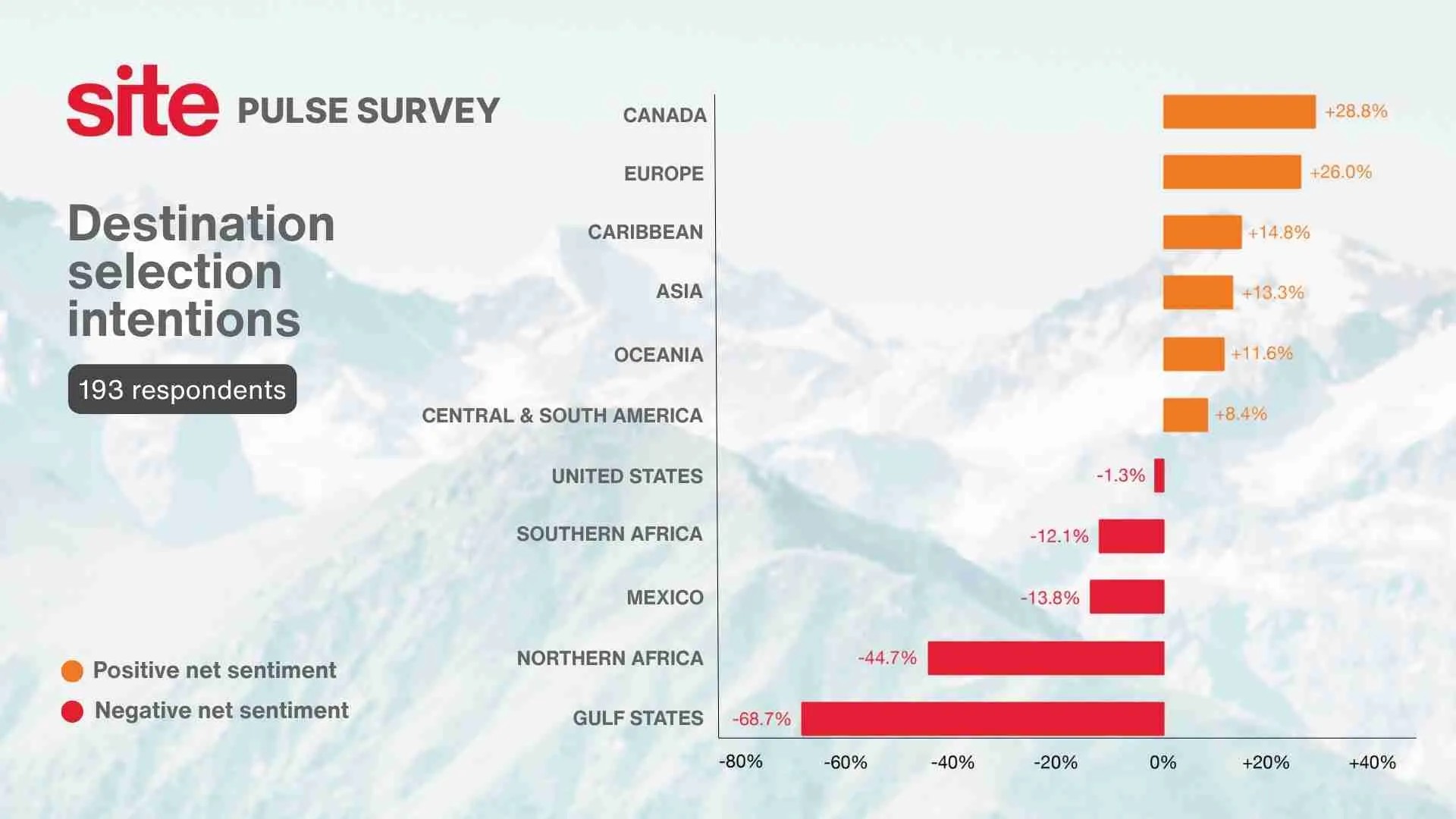
Canada recorded a net sentiment score of +66.7% among European respondents and +46.4% among Rest of World respondents. It also remained positive among US respondents, at +15.1%, making it the most consistent performer across source markets. By contrast, the Gulf States recorded negative sentiment across all respondent groups, including -82.1% among US respondents, -72.4% among Europeans, -54.2% among Rest of World respondents and -21.4% among Asian respondents.
These figures do not suggest that incentive travel demand is disappearing. Rather, they point to a reallocation of demand. Planners are not stepping away from incentive travel. They are rethinking where programmes can be delivered with confidence.
For destination organizations, that distinction is important. In periods of disruption, destinations that are seen as stable, accessible, reliable and aligned with client expectations can gain ground quickly. Equally, destinations that are perceived as exposed to geopolitical, social or reputational risk can see confidence fall, even when their product remains strong.
This is where the survey aligns so closely with Destinations International’s Resilience and Readiness focus. Readiness is not only about crisis response after disruption occurs. It is about understanding where vulnerability may exist, how market perception is changing and what messages, partnerships and proof points are needed before confidence is tested.
For incentive travel, perception is part of the destination product. A programme must feel right to the sponsoring company, the planner, the participants and, increasingly, the wider stakeholder audience around the trip. Incentive travel is highly emotional because it is linked to recognition, reward and belonging. The destination selected for a programme becomes part of the employer’s message to its top performers.
That makes trust a commercial asset.
Destination organizations can respond in several ways. First, they can treat sentiment as a live market signal rather than a soft measure. Traditional performance indicators remain essential, but destination leaders also need to understand how buyers feel about their destination and why. Are concerns linked to safety, air access, political climate, cost, sustainability, inclusivity, community welcome or something else? Without that insight, destinations risk answering yesterday’s question.
Second, destinations can equip their partners with clear, consistent and credible messaging. Incentive planners need reassurance they can use with corporate clients. DMCs, hotels, venues, airlines and local experience providers all have a role in reinforcing confidence. A destination’s response is strongest when the public and private sectors are aligned around the same facts, values and practical solutions.
Third, destination organizations can connect resilience with placemaking. The most compelling incentive destinations are not simply safe or operationally capable. They are places where visitors can connect meaningfully with local culture, people and purpose. Programmes that reflect resident priorities, support local enterprises and deliver positive community value are better placed to meet the expectations of modern incentive buyers.
This is especially important because incentive travel decisions are increasingly shaped by alignment. Companies want destinations that reflect the tone of their brand and the expectations of their workforce. A destination’s local story, its community partnerships and its stewardship credentials are no longer secondary. They can be central to why a programme is approved.
The SITE Pulse Survey also highlights the need for agility. Sentiment can shift faster than long-term strategy cycles. A destination may spend years building awareness in a particular market, only to find that a geopolitical event, policy change or reputational issue changes buyer confidence in weeks. That does not mean destinations should constantly change direction. It does mean they need the systems, relationships and intelligence to respond quickly.
For some destinations, the opportunity will be to capture displaced demand. Canada’s strong performance in the survey shows how destinations perceived as stable and experience-rich can benefit when planners look for alternatives. Europe’s positive sentiment among European respondents, at +53.7%, also suggests that proximity, familiarity and confidence can become powerful advantages during uncertain periods.
For others, the priority will be reassurance. The United States, for example, showed a mixed picture in the survey. US respondents remained positive about domestic programmes, with a net sentiment score of +22.8%, but non-US respondents were negative, including -19.4% among Europeans, -33.3% among Asians and -34.6% among Rest of World respondents.
That kind of split matters. It suggests that destinations cannot assume one global message will work across all markets. Sentiment may vary significantly by source market, and destination organizations need to understand those differences before they communicate.
The broader lesson is clear. Incentive travel remains resilient, but destination choice is becoming more sensitive to global conditions and buyer perception. Destination organizations that invest in market intelligence, community alignment, partner readiness and clear storytelling will be better positioned to navigate disruption and convert uncertainty into opportunity.
Incentive travel is still about exceptional experiences. But in today’s environment, exceptional experiences must also feel responsible, secure, aligned and easy to defend.
For destinations, readiness is no longer just operational. It is emotional, reputational and strategic. And as the SITE Pulse Survey shows, those destinations that understand sentiment early will be best placed to earn confidence when it matters most.

Annette Gregg, CMM, MBA, is the CEO of the Society for Incentive Travel Excellence (SITE), leading its 2,500 global members and the SITE Foundation. With extensive experience in the meetings and hospitality industry, she has held executive roles in corporations, associations, and non-profits. Annette is a sought-after keynote speaker on diversity, unconscious bias, and women's advancement. She has been recognized with honors such as Women in Tourism and Hospitality, the Association of Women in Events' Coach Award, and Smart Women Industry Leader.
Share Your Expertise
Want Your Organization Featured Next?
The article you just read was written by someone like you. Submit a blog, case study or social media feature and get your organization's story in front of the DI community.
Join 50+ destination leaders who've shared their stories on the DI Blog